

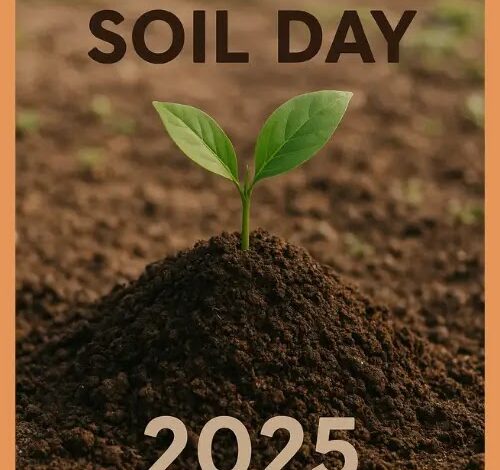
Every year on 5 December, the global community celebrates World Soil Day (WSD), a United Nations observance led by the Food and Agriculture Organization (FAO). Officially recognized in 2014, the date also honours the birthday of His Late Majesty King Bhumibol Adulyadej of Thailand, who devoted decades to sustainable soil management. The theme for World Soil Day 2025 is “Soil and Water: A Source of Life”. This theme could not be more urgent. Soil and water are not independent resources; they form a living, interdependent system that underpins food security, clean drinking water, climate regulation, biodiversity, and human civilisation itself.
The Invisible Crisis Beneath Our FeetMost people rarely think about soil. Yet soil is the thin, fragile skin of Earth—on average just 20–30 cm deep in agricultural areas—that feeds 95% of humanity. A single handful of healthy soil contains more microorganisms than there are humans on the planet. Today, we are losing soil 10–40 times faster than it is naturally replenished. The United Nations Convention to Combat Desertification (UNCCD) estimates that 33% of global soils are already moderately to highly degraded due to erosion, compaction, salinization, nutrient depletion, acidification, pollution, and loss of organic carbon. If current trends continue, up to 90% of Earth’s soils could be degraded by 2050.
{tocify} $title={Table of Contents}
Soil and Water: An Inseparable Partnership
Healthy soil performs miraculous water-related services:
Sponge Effect and Drought Mitigation
Soils with high organic matter (3–6%) can store 150,000–200,000 litres of plant-available water per hectare for every 1% increase in organic matter. In contrast, degraded soils with less than 1% organic matter repel water, intensifying drought stress for crops and ecosystems.
Natural Filtration and Groundwater Protection
As rainwater percolates through biologically active soil layers, microbes and soil particles remove pathogens, heavy metals, excess nutrients, and pesticides. Degraded or sealed soils allow these pollutants to reach aquifers directly. Globally, over 2 billion people depend on groundwater that is increasingly threatened by poor soil management.
.webp "World Soil Day 2025") |
| World Soil Day 2025 |
Flood Prevention
Intact soil with good aggregation and pore space can absorb 200–400 mm of rain per hour—far more than most intense rain events. Compacted or sealed soils absorb less than 10 mm/hour, turning rainfall into destructive runoff. The devastating 2021 floods in Germany and 2022 floods in Pakistan were worsened by decades of soil compaction and loss of vegetative cover.
Carbon Sequestration and Climate Regulation
Soils hold approximately 1,500–2,400 billion tonnes of organic carbon—more than the atmosphere and all vegetation combined. Healthy soil-water systems help draw down atmospheric CO₂ while buffering climate change.
The Scale of the Current Crisis
- Every 5 seconds, soil equivalent to one football field erodes.
- 24–30 billion tonnes of fertile soil are lost annually.
- Soil degradation costs the global economy an estimated US$400 billion per year.
- 52% of agricultural land is already moderately or severely degraded (FAO, 2022).
- By 2050, soil degradation could reduce global crop yields by 10–50% in some regions, pushing hundreds of millions deeper into hunger.
Regional Spotlights
- Sub-Saharan Africa: Wind and water erosion remove 5–15 tonnes of soil per hectare annually in many areas, compounded by low organic matter and overgrazing.
- South Asia: Intensive rice-wheat systems and groundwater overexploitation have caused severe soil salinization and waterlogging.
- Europe: 23% of land shows unsustainable soil organic carbon loss; urban sprawl seals 500 km² of soil every year.
- Amazon and Indonesia: Deforestation for soy, palm oil, and cattle ranching has triggered massive soil carbon release and disrupted regional rainfall patterns.
Proven Solutions That Work
Fortunately, 2025 brings hope through scalable, nature-positive practices:
Regenerative Agriculture
Cover cropping, crop rotation, reduced tillage, and integration of livestock have increased soil organic carbon by 0.4–2% per year on millions of hectares worldwide. The “4 per 1000” initiative shows that a modest annual increase of 0.4% in global soil carbon stocks would offset anthropogenic CO₂ emissions.
Agroforestry and Farmer-Managed Natural Regeneration
In Niger, farmers have regreened 5 million hectares of degraded land, raising water tables by 10–20 metres and producing an extra 500,000 tonnes of cereals annually.
Conservation Agriculture
Adopted on over 180 million hectares globally, it reduces erosion by up to 90% and water use by 30%.
Wetland and Riparian Buffer Restoration
Restoring natural sponges along rivers prevents downstream flooding and improves water quality.
Urban Soil Revival
Cities like Singapore, Copenhagen, and New York are de-sealing soils, creating rain gardens, green roofs, and permeable pavements to restore the soil-water cycle.
Role of Policy and Global Commitments
The UN Decade on Ecosystem Restoration (2021–2030), the Sustainable Development Goals (especially SDG 15.3 on Land Degradation Neutrality), and the Koronivia Joint Work on Agriculture provide frameworks for action. Countries such as Ethiopia, Costa Rica, India, and China have launched ambitious national programmes to restore tens of millions of hectares.
What Individuals and Communities Can Do on 5 December 2025 and Beyond
- Organise or join local soil celebrations—soil painting with children, farm visits, composting workshops.
- Start a home or community compost system.
- Reduce food waste (one-third of food produced is wasted, squandering the soil and water embedded in it).
- Support brands and farmers practising regenerative methods.
- Plant trees, maintain ground cover, and avoid walking on wet soils to prevent compaction.
- Advocate for policies that pay farmers for ecosystem services (carbon sequestration, water retention, biodiversity).
Conclusion: A Day to Act, Not Just the Beginning
World Soil Day 2025 is not merely a commemoration; it is a global wake-up call and a celebration of solutions. The theme “Soil and Water: A Source of Life” reminds us that these two elements are the very foundation of existence. When we degrade soil, we break the water cycle. When we heal soil, we restore water, food, climate stability, and hope.
Beneath our feet lies not just dirt, but the living fabric that connects all life. On 5 December 2025, let us pledge to protect, restore, and celebrate this precious alliance.
- Because healthy soil means available water.
- Available water means abundant food.
- Abundant food means peace, prosperity, and a liveable planet—for us and for every generation to come.
- Happy World Soil Day 2025!
Let us keep the soil alive, so life itself can thrive.
FAQs World Soil Day 2025
Theme: “Soil and Water: A Source of Life”
Q. When is World Soil Day celebrated and why on 5 December?
World Soil Day is celebrated every year on 5 December. The date was chosen by the United Nations to honor the birthday of His Late Majesty King Bhumibol Adulyadej of Thailand, who was a global champion of sustainable soil management for over 60 years.
Q. What is the official theme for World Soil Day 2025?
The official theme for 2025 is “Soil and Water: A Source of Life”. It emphasizes the critical and inseparable relationship between healthy soil and clean, available water for food production, ecosystems, and human well-being.
Q. Why are soil and water together in 2025?
Healthy soil acts like a giant sponge that stores and filters water, prevents floods and droughts, recharges groundwater, and supports plant growth. When soil degrades, the entire water cycle is disrupted, leading to food insecurity, water scarcity, and increased climate risks. The 2025 campaign highlights that protecting soil is one of the most effective ways to secure water for future generations.
Q. How much soil are we losing globally and what does it mean for water?
Every year, the world loses 24–30 billion tonnes of fertile soil due to erosion, urbanization, and poor farming practices. This is equivalent to losing a soccer field of soil every 5 seconds. Degraded soil can no longer hold or filter water properly, causing more severe droughts, floods, polluted rivers, and depleted aquifers.
Q. What can I personally do to support the 2025 World Soil Day message?
- Compost kitchen and garden waste to return organic matter to the soil.
- Reduce food waste (one-third of all food is wasted, wasting the soil and water used to produce it).
- Plant trees or maintain ground cover to prevent erosion.
- Support farmers and brands that practice regenerative or conservation agriculture.
- Participate in or organize local events on 5 December 2025—soil painting, farm visits, tree planting, or workshops.
- Small actions by millions of people can collectively protect the vital partnership between soil and water—the true source of life.
Source link