

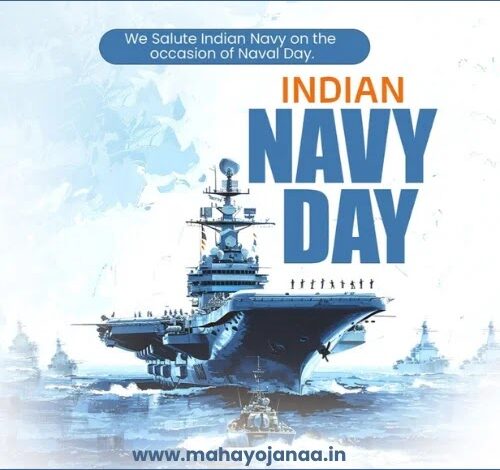
Every year on December 4, India pauses to honor its maritime sentinels—the brave men and women of the Indian Navy—who stand as the first line of defense against threats emerging from the vast expanse of the oceans. Indian Navy Day is not merely a date on the calendar; it is a resounding tribute to valor, sacrifice, and strategic brilliance. Rooted in the historic triumph of Operation Trident during the 1971 Indo-Pak War, this observance commemorates the Navy’s pivotal role in securing the nation’s maritime borders and projecting India’s influence across the Indian Ocean Region (IOR). As we approach Navy Day 2025, the celebrations promise to be a spectacle of innovation and resolve, underscoring the theme “MAHASAGAR – Mutual and Holistic Advancement for Security and Growth Across Regions.” This theme encapsulates the Navy’s vision of collaborative maritime security, fostering partnerships that ensure safe seas for trade, diplomacy, and prosperity.
In an era where over 90% of global trade sails through oceanic routes, the Indian Navy’s mandate extends far beyond defense. It safeguards a coastline spanning 7,516 kilometers, protects exclusive economic zones rich in resources, and counters non-traditional threats like piracy and illegal fishing. Navy Day 2025 arrives at a pivotal moment, as the force accelerates its transformation into a “Combat Ready, Cohesive, Credible, and Aatmanirbhar Force.” With recent achievements bolstering its capabilities and ambitious plans charting a course for dominance in the IOR, this essay explores the historical significance of Navy Day, the grandeur of 2025’s celebrations, key milestones from 2024-2025, and the horizon ahead. Through these lenses, we celebrate a Navy that embodies India’s aspirations for a ‘Viksit Bharat’—a developed and prosperous nation.
{tocify} $title={Table of Contents}
Historical Significance: From Operation Trident to National Pride
The genesis of Indian Navy Day lies in the crucible of conflict, a testament to how audacious naval action can alter the tides of history. Established on December 4, 1971, the day marks the execution of Operation Trident, a daring nocturnal strike by the Indian Navy’s missile boats on Pakistan’s Karachi harbor during the Indo-Pak War. Under the cover of darkness, three Soviet-supplied Osa-class boats—INS Nirghat, INS Nipat, and INS Veer—armed with the indigenously adapted Styx missiles, unleashed a barrage that sank the Pakistani destroyer PNS Khaibar, the minesweeper PNS Muhafiz, and a cargo ship carrying ammunition, while severely damaging the oil tanker PNS Ghazi. This was the first use of anti-ship missiles in combat, inflicting over 1,000 casualties and crippling Pakistan’s naval logistics without a single Indian loss. Followed by Operation Python on December 8-9, it sealed the Navy’s dominance in the Arabian Sea, hastening the birth of Bangladesh and India’s victory.
The decision to commemorate this feat annually was formalized at the Senior Naval Officers’ Conference in May 1972, shifting Navy Day from its colonial-era observance on October 21 (Trafalgar Day) or December 1 (post-WWII) to December 4. This change symbolized India’s emergence as a sovereign maritime power, evolving from the Royal Indian Navy—founded in 1612 under British rule—to a blue-water force capable of projecting power beyond its shores. The significance of Navy Day transcends remembrance; it instills national pride, educates the youth on maritime heritage, and reinforces the Navy’s role in non-combat missions like disaster relief and humanitarian assistance. From the 2004 Tsunami response, where the Navy evacuated over 30,000 people, to anti-piracy patrols in the Gulf of Aden, it embodies the Sanskrit adage: “Jalam eva yasya, balam eva tasya” (He who controls the water controls power).
In 2025, as the 54th anniversary unfolds, Navy Day serves as a mirror to India’s geopolitical ascent. Amid rising tensions in the IOR—exacerbated by China’s String of Pearls strategy and Houthi disruptions—the Navy’s historical legacy inspires resilience. It reminds us that maritime security is the bedrock of economic stability, with India’s blue economy projected to reach $100 billion by 2030. By honoring the martyrs of 1971, Navy Day fosters a collective resolve to protect not just borders, but the very arteries of national progress.
Celebrations in 2025: A Showcase of Maritime Might
Navy Day 2025 promises an electrifying fusion of tradition and technology, shifting the spotlight to the sun-kissed shores of Thiruvananthapuram, Kerala—a deliberate move to decentralize events and connect with coastal communities. Unlike the traditional grandeur at Mumbai or Visakhapatnam, this year’s centerpiece is a grand Operational Demonstration at Shangumugham Beach on December 3 (advanced from December 4 due to the India-Russia Summit). President Droupadi Murmu, as Supreme Commander, will preside, inaugurating the event alongside the newly renamed Lok Bhavan, underscoring the Navy’s role in national integration.
 |
| Indian Navy Day 2025 |
The demonstration will be a multi-domain extravaganza, featuring coordinated maneuvers by surface ships, submarines, and aerial assets. Spectators will witness the indigenous aircraft carrier INS Vikrant launching fighter jets in thunderous sorties, stealth frigates executing precision strikes, and submarine-launched missiles piercing the horizon—mirroring the audacity of Operation Trident. Advanced systems like the BrahMos supersonic cruise missile and Barak-8 surface-to-air defenses will highlight Aatmanirbhar Bharat’s fruits, with over 90% indigenization in key platforms. Preceding the main event, Navy Week (December 1-7) will buzz with public engagements: open-ship visits for schoolchildren, a half-marathon, inter-school quizzes, veteran luncheons, and symphonic orchestra performances by the Naval Symphonic Orchestra. At bases like Kochi and Port Blair, exhibitions and air displays will educate on marine commando operations and rescue drills.
This rotational hosting—Puri in 2024, Sindhudurg in 2023—amplifies outreach, drawing lakhs to witness the Navy’s evolution. Social media campaigns will amplify the fervor, sharing veteran stories and live feeds, while eco-friendly initiatives like digital greetings promote sustainability. For the youth, it’s an invitation to aspire: career seminars and interactive zones will demystify naval life, inspiring the next generation of officers. In essence, 2025’s celebrations are not just parades but a vivid narrative of a Navy that turns the sea from a frontier into a fortress of opportunity.
Recent Achievements and Future Horizons: Sailing Towards Supremacy
The Indian Navy’s trajectory from 2024-2025 has been one of relentless momentum, marked by operational triumphs and indigenous leaps. Under Operation Sankalp, over 10 warships patrolled the Gulf of Aden and Arabian Sea, thwarting Houthi attacks on merchant vessels and ensuring safe passage for 1,000+ ships— a feat lauded globally for its “unwavering” anti-piracy commitment. Domestically, the triple commissioning on January 15, 2025—INS Vagsheer (Kalvari-class submarine), INS Surat (Visakhapatnam-class destroyer), and INS Nilgiri (next-gen frigate)—outpaced the entire 2024 inductions, signaling a shipbuilding renaissance. By October 2025, 10 warships and a submarine joined the fleet, with four more slated by year-end, pushing the total to over 140 vessels. Gallantry awards at the Naval Investiture Ceremony honored units like INS Teg and INS Kolkata for distinguished service, while green initiatives earned accolades for Naval Dockyard Mumbai.
Looking ahead, the Technology Perspective and Capability Roadmap (TPCR) 2025 charts a bold 15-year blueprint: expanding to 175-200 warships by 2035 and 230 by 2037, with 54 under construction as of September 2025. Key acquisitions include 26 Rafale-M fighters for carriers by 2030, four Landing Platform Docks (LPDs) for amphibious ops, and next-gen corvettes with electric propulsion. Submarine ambitions soar with six SSNs and 18 conventional boats, alongside a 400-aircraft fleet for surveillance. Upgrades to Andaman & Nicobar and Lakshadweep bases will fortify IOR outposts, countering adversarial encroachments.
These strides embody self-reliance: from 50% indigenization in 2024 to 90% today, the Navy commissions a vessel every 40 days, transitioning from “buyer’s” to “builder’s” navy. Collaborations like the India-Japan UNICORN mast project and HAL’s TEDBF fighter herald a future of unmanned swarms and directed-energy weapons. Yet, challenges persist—budget constraints and supply chain delays demand vigilant stewardship. As Navy Day 2025 unfolds, it reaffirms the Navy’s oath: to secure the seas for a secure India.
Conclusion
Indian Navy Day 2025 is more than commemoration; it is a clarion call to unity and ambition. From the echoes of Operation Trident to the roar of INS Vikrant’s jets over Thiruvananthapuram, it weaves history with hope, honoring sacrifices while igniting dreams. In an unpredictable world, the Indian Navy stands as our unbreakable shield—ensuring that the tricolor flies high over every wave. As we salute our guardians, let us pledge: their vigilance today for our prosperity tomorrow. Jai Hind!
Indian Navy Day 2025 FAQ
Q. When is Indian Navy Day celebrated and why on December 4?
Indian Navy Day is celebrated every year on December 4 to mark the daring success of Operation Trident in 1971, when the Indian Navy carried out a devastating attack on Karachi harbor during the Indo-Pak War, sinking several Pakistani warships without losing a single Indian vessel.
Q. Where will the main Navy Day 2025 event be held?
The main Operational Demonstration for Navy Day 2025 will be held at Shangumugham Beach, Thiruvananthapuram (Trivandrum), Kerala. This is the first time the event is being hosted in Kerala.
Q. Who will be the Chief Guest for Indian Navy Day 2025?
President Droupadi Murmu, the Supreme Commander of the Indian Armed Forces, will be the Chief Guest and will review the Operational Demonstration on December 3, 2025 (shifted one day earlier due to the India-Russia Summit scheduled on December 4).
Q. What is the theme of Indian Navy Day 2025?
The official theme is “MAHASAGAR – Mutual and Holistic Advancement for Security and Growth Across Regions”, emphasizing collaborative maritime security, regional stability, and shared prosperity in the Indo-Pacific.
Q. What can the public expect to see during the 2025 celebrations?
Highlights include:
- Air show with MiG-29K, Hawk, and Chetak aircraft
- Warships, submarines, and missile demonstrations
- Flypast and maneuvers by indigenous INS Vikrant carrier group
- Marine commando (MARCOS) assault demonstration
- Beating Retreat and naval band performances
- Ship visits, exhibitions, and Navy Week activities across the country from December 1–7
Source link